
FSHD UK
// ABOUT FSHD
OVERVIEW
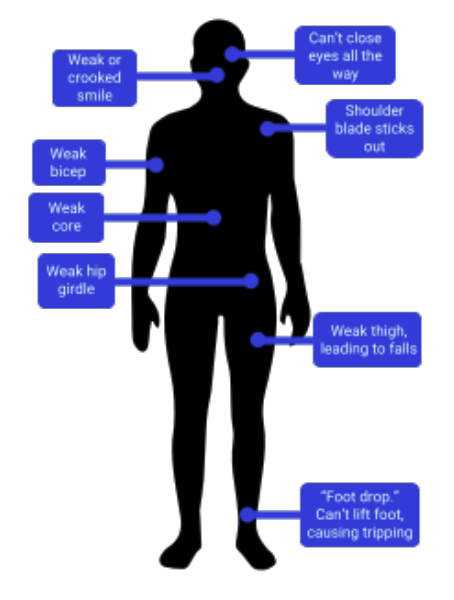
Facioscapulohumeral muscular dystrophy (FSHD) is a disorder characterized by muscle weakness and wasting (atrophy). The disorder gets its name from muscles that are affected in the face (facio), around the shoulder blades (scapulo), and in the upper arms (humeral). Hamstring and trunk muscles are affected -early on but are less well recognized. Other arm and leg muscles are frequently eventually affected in the course of the disease. Symptoms usually appear before age 20, but can begin in infancy or later in adulthood. Severity of the condition varies widely and some people with the disease allele remain asymptomatic. FSHD is most typically characterized by relatively slow disease progression. Specific symptoms and findings may also vary in range and severity, including among affected members of the same family. Life expectancy is not shortened. FSHD is usually inherited as an autosomal dominant genetic condition’ – NORD National Organisation for Rare Disorders
FSHD is formally diagnosed through a blood test. Most clinical trials will request this as a formal confirmation of the condition. There are saliva tests available via a research study run by the Peter Jones and Takako Jones lab. Note: these are not currently formally recognised. To learn more: https://myfshd.org/test-for-fshd/
It was estimated by a European study in 2013 (taking a prevalence rate of 12/100,000 people with FSHD and the population at that time of c67.33 million in the UK) that there could be c.8000 FSHD patients in the UK. (Footnote 1). There could be more.